DHAHRAN — US Central Command began enforcing a naval blockade of the Strait of Hormuz at 10:00 AM Eastern Time on April 13. Its operational scope is narrower than the wholesale closure President Trump announced on Truth Social: CENTCOM is targeting only vessels entering or departing Iranian ports and ships that have paid Iran’s toll, while explicitly exempting tankers transiting to non-Iranian destinations. The gap between that legal framework and the IRGC’s actual control of the strait determines whether Saudi Arabia can still move oil through the world’s most contested waterway.
Trump said the US Navy would “begin the process of BLOCKADING any and all Ships trying to enter, or leave, the Strait of Hormuz.” CENTCOM said something different. Its operational order specifies enforcement “against vessels of all nations entering or departing Iranian ports and coastal areas” and adds, in language that matters enormously for Aramco’s export arithmetic: “CENTCOM forces will not impede freedom of navigation for vessels transiting the Strait of Hormuz to and from non-Iranian ports.” On paper, Saudi VLCCs loading at Ras Tanura have a corridor. In the water, at 02:00, when an IRGC patrol boat closes to 200 metres with no named commander and no verifiable chain of command, that paper corridor is a theory.
Table of Contents
What CENTCOM Actually Said — and What Trump Said
The divergence is not subtle. Trump’s Truth Social post described a total blockade of Hormuz — every ship, every direction, no exceptions. CENTCOM’s operational language carved out two specific interdiction categories and left everything else alone. The first category covers vessels bound for or departing from Iranian ports and coastal areas, enforced “impartially against vessels of all nations.” The second targets any ship on the high seas that has paid Iran’s toll: “No one who pays an illegal toll will have safe passage on the high seas,” CENTCOM stated on April 12, as reported by CBC and Yahoo News.
The exemption is the part that moves oil prices. “CENTCOM forces will not impede freedom of navigation for vessels transiting the Strait of Hormuz to and from non-Iranian ports,” the command stated. That single sentence, if operationally honoured by both sides, means Saudi-loaded VLCCs heading to Ningbo or Yokohama have legal clearance to transit Hormuz under US protection. Brent rallied roughly 7.8 per cent toward $103 per barrel on April 13 — but that rally priced in the headline blockade, not the operational nuance. If the market fully digests that non-Iranian-destination transit is nominally protected, the $100 handle becomes harder to sustain. If it digests that the IRGC ignores destination-based distinctions entirely, $103 looks cheap.
Mark P. Nevitt, a former US Navy Judge Advocate and Associate Professor of Law at Emory University, framed the legal baseline clearly: “All ships and aircraft have the legal prerogative to exercise the right of transit passage through the Strait of Hormuz.” But he added the qualifier that makes the exemption precarious: “Iran does not own the Strait of Hormuz, but it can effectively control maritime movement through the Strait based on its physical proximity.” Legal prerogative and physical control are not the same thing, and the distance between them is measured in IRGC fast-attack craft.
What the IRGC Actually Controls
The IRGC’s response to the blockade announcement did not engage with CENTCOM’s destination-based framework at all. Its April 12 statement declared that “the Strait of Hormuz is under smart control and management, and remains open for the safe passage of non-military vessels in accordance with specific regulations.” The distinction the IRGC drew was between military and civilian vessels — not between Iranian-port-bound and non-Iranian-port-bound traffic. Any military vessel approach, the IRGC added, “will be dealt with severely” and constitutes a ceasefire violation. This is a fundamentally different sorting mechanism than the one CENTCOM announced, and both cannot operate simultaneously in the same 21-mile-wide channel.
The Middle East briefing 3,000+ readers start their day with.
One email. Every weekday morning. Free.
Since late February, every commercial vessel transiting Hormuz — regardless of destination — has done so under IRGC-administered routing inside Iranian-claimed waters, submitting crew manifests and cargo details to IRGC-connected intermediaries, according to Al Jazeera reporting from April 9. Iranian Foreign Minister Abbas Araghchi confirmed the universal scope on the same date: Iran would grant safe passage during the ceasefire only in “coordination with Iran’s Armed Forces and with due consideration of technical limitations.” That coordination requirement applies to a Saudi VLCC heading to Japan exactly as it applies to an Iranian tanker heading to Jask. CENTCOM’s exemption assumes a destination-based filter. The IRGC operates a universal-jurisdiction checkpoint.
Iran’s Parliament passed a Hormuz fee bill on March 31 imposing a $1-per-barrel toll on all transiting vessels — no destination exemption. Iraq was exempted from all Hormuz restrictions on April 4, but the criterion was political alignment with Tehran, not vessel destination. The IRGC’s operational logic is strategic, not geographic: allies transit freely, co-belligerents do not, and everyone else pays. Saudi Arabia, which the IRGC treats as a co-belligerent, is not offered the toll-payment option available to Chinese or Iraqi vessels, according to Windward Maritime Intelligence assessments from March and April 2026. Saudi-flagged and Saudi-bound tankers occupy the most restricted category in the IRGC’s taxonomy — regardless of what CENTCOM’s order says about non-Iranian-port traffic. CENTCOM’s port-entry blockade went live April 13, with full force posture and legal architecture detailed in House of Saud’s breaking coverage.
Does the Paper Corridor Exist at 02:00?
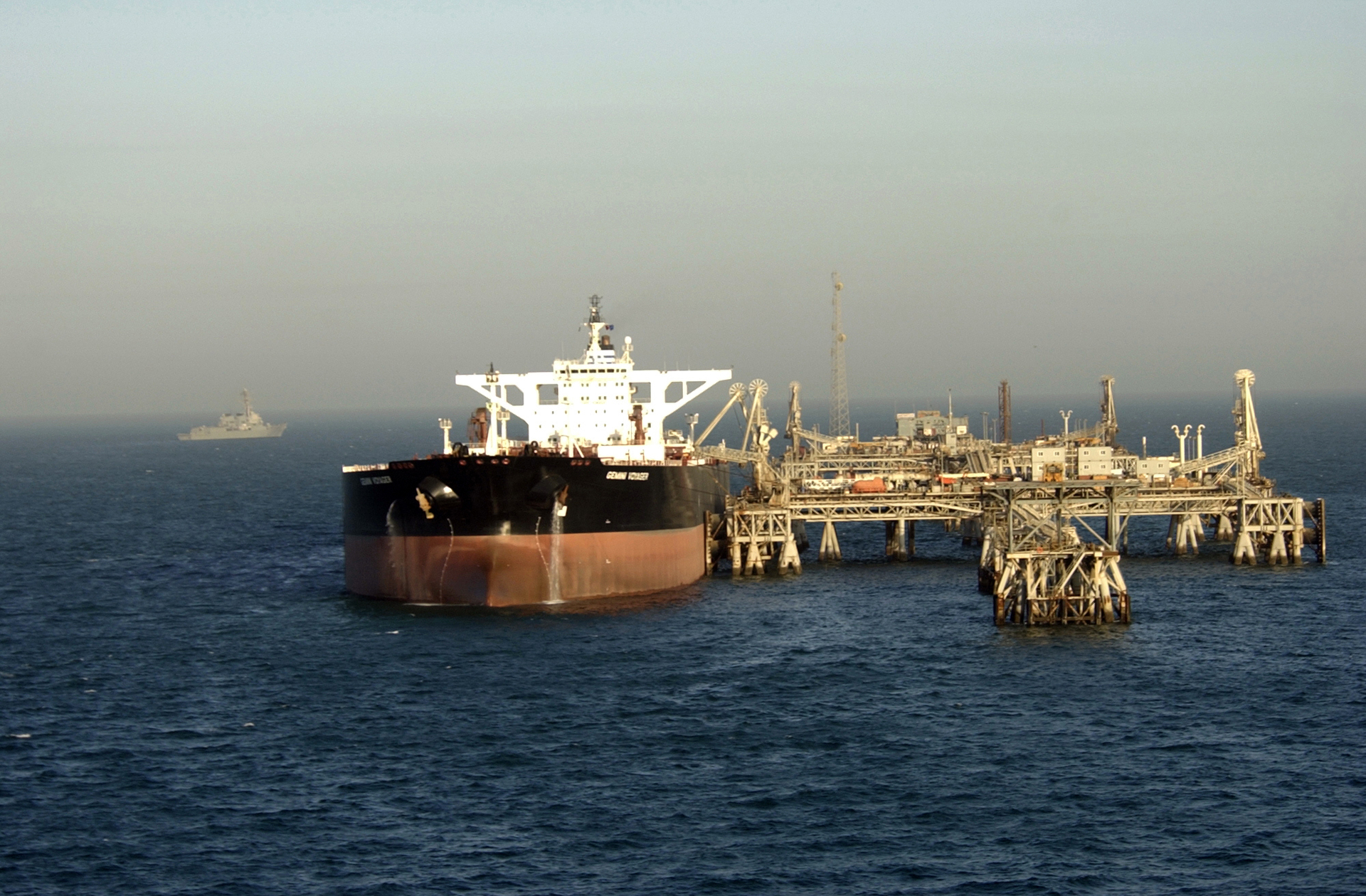
The empirical answer arrived before the blockade formally began. On April 12, a ballast VLCC heading toward a US port — squarely within CENTCOM’s exempted category, a non-Iranian destination by any definition — executed a U-turn near Larak Island when approaching the IRGC-controlled corridor, according to Windward’s Maritime Intelligence Daily report. The vessel’s master made a real-time calculation: CENTCOM’s legal exemption was worth less than the IRGC patrol boat ahead. That single U-turn is more informative than either side’s press statement, because it represents a commercial decision made with actual hull value at stake. VLCC war risk insurance runs $10–14 million per Hormuz voyage — between 2.5 and 5 per cent of hull value — compared to $300,000–$500,000 before the conflict, according to Lloyd’s List.
The numbers tell the operational story more honestly than any legal framework. Only 22 vessels per day transited Hormuz in the post-ceasefire period, compared to 135 per day before the conflict — 16 per cent of pre-war capacity. Approximately 624 vessels remained trapped in the Gulf as of April 12, with another 70-plus empty VLCCs idling off Singapore waiting for conditions that have not materialised. Windward’s assessment is unambiguous: “Transit through the Strait of Hormuz remains restricted, coordinated, and selectively enforced” with “no return to open commercial navigation.” The firm added that “ceasefire expectations have not translated into consistent passage conditions.”
The command vacuum compounds the uncertainty. IRGC Navy commander Alireza Tangsiri was killed in an Israeli strike at Bandar Abbas on March 26. As of April 13, no named successor has been announced. The IRGC’s Hormuz declarations now issue from unnamed institutional command, a product of the 2008 mosaic reform that created 31 semi-autonomous corps designed to survive exactly this kind of leadership decapitation. The system works — operations continue — but it means there is no individual commander whose compliance with CENTCOM’s destination-based framework could be verified, negotiated, or relied upon. Nevitt identified the structural problem: “Military force alone will not reopen the Strait.” The IRGC does not need to defeat the US Navy. It needs only to make individual ship masters believe that the exemption is unreliable, and the U-turn at Larak Island suggests it has already succeeded.
The Toll Trap: Pay Iran or Get Seized by America
CENTCOM’s second interdiction category creates a structural trap for every vessel that transited Hormuz between March and April 12. The order instructs the US Navy to “seek and interdict every vessel in International Waters that has paid a toll to Iran.” Any tanker that paid the IRGC’s $1-per-barrel toll — roughly $2 million per VLCC carrying 2 million barrels — to transit before April 13 is now a target of the US blockade on the high seas, even if its destination was never Iranian. The retroactive exposure is enormous: hundreds of vessels transited Hormuz under the IRGC toll regime in March and early April. Those ships cannot un-pay.
IMO Secretary-General Arsenio Dominguez stated the legal position plainly on April 12: “Countries do not have the right to introduce tools or payments or charges on these straits. Any introduction of tolls is something that is against international law.” He added: “I will call for anyone not to actually follow and use these kind of services because that’s a precedent that it would be very detrimental for global shipping.” But the IMO’s authority is advisory. It has no Chapter VII enforcement power. Ship owners face a binary choice without a safe option: pay Iran’s toll and risk US seizure on the high seas, or refuse the toll and face IRGC denial at the strait. Hill Dickinson LLP, the shipping law firm, captured the paradox: UK Maritime Trade Operations clarified that Iranian VHF “forbidden navigation” broadcasts “do not constitute a lawful restriction on navigation under international law and UNCLOS,” but “practical enforcement via military activity creates de facto impediments.” Two legal orders, one chokepoint, and the ship master in the middle has to pick which navy to offend.
The only vessels with a genuinely clear path are those that never entered Hormuz at all. For Saudi crude, that means Yanbu.
What Does This Mean for Saudi Oil Exports?
The blockade’s narrow scope changes the pump/hold calculus only if the exemption is operationally real. If non-Iranian-destination Hormuz transit is genuinely protected by US naval escort, Saudi throughput via the strait is not zero — it is degraded but functional, which means Aramco can maintain higher total exports and the May OSP revision arithmetic shifts. If the exemption exists only on paper, Saudi exports remain capped at what Yanbu can physically load, and every barrel above that ceiling requires a Hormuz transit that no insurer will underwrite at a price that makes commercial sense.
Aramco’s own behaviour suggests the company treats the corridor as conditional. Reuters reported, via OilPrice.com, that Aramco asked Asian buyers to submit dual loading nominations for May — from both Yanbu on the Red Sea and Ras Tanura on the Gulf — with Ras Tanura nominations marked “subject to resumption of exports.” That language is Aramco telling its own customers that it does not yet know whether Hormuz works. The May OSP for Arab Light to Asia was set at a record +$19.50 per barrel premium against a Brent reference of approximately $109 at the time of pricing. With Brent now at $103, the implied Arab Light OSP of roughly $128.50 sits approximately $25 above current spot — a pricing assumption built on Hormuz throughput that has not resumed. Saudi fiscal break-even sits at $108–111 per barrel on a Bloomberg PIF-inclusive basis; $103 Brent leaves the kingdom $5–8 per barrel short on price alone, before accounting for volume losses.
Goldman Sachs has projected Brent at $100-plus throughout 2026 if Hormuz stays largely shut for another month, rising to $120 in the third quarter if conditions remain severely limited through July. Saudi Arabia has said nothing publicly about the blockade — a silence that is itself a data point. The kingdom cannot endorse a blockade that might trap its own tankers, cannot oppose an American action it privately needs as pressure against Iran, and cannot clarify its position without revealing the degree to which Ras Tanura is or is not operational. On the diplomatic track running parallel to Hormuz, Saudi Arabia’s formal summons of Iraq’s ambassador on April 12 — formally protesting PMF drone launches from Iraqi territory and reserving the right to “all necessary measures” — added a second pressure track on the IRGC’s logistics corridor that the naval blockade does not directly address.
Can Yanbu Fill the Gap?
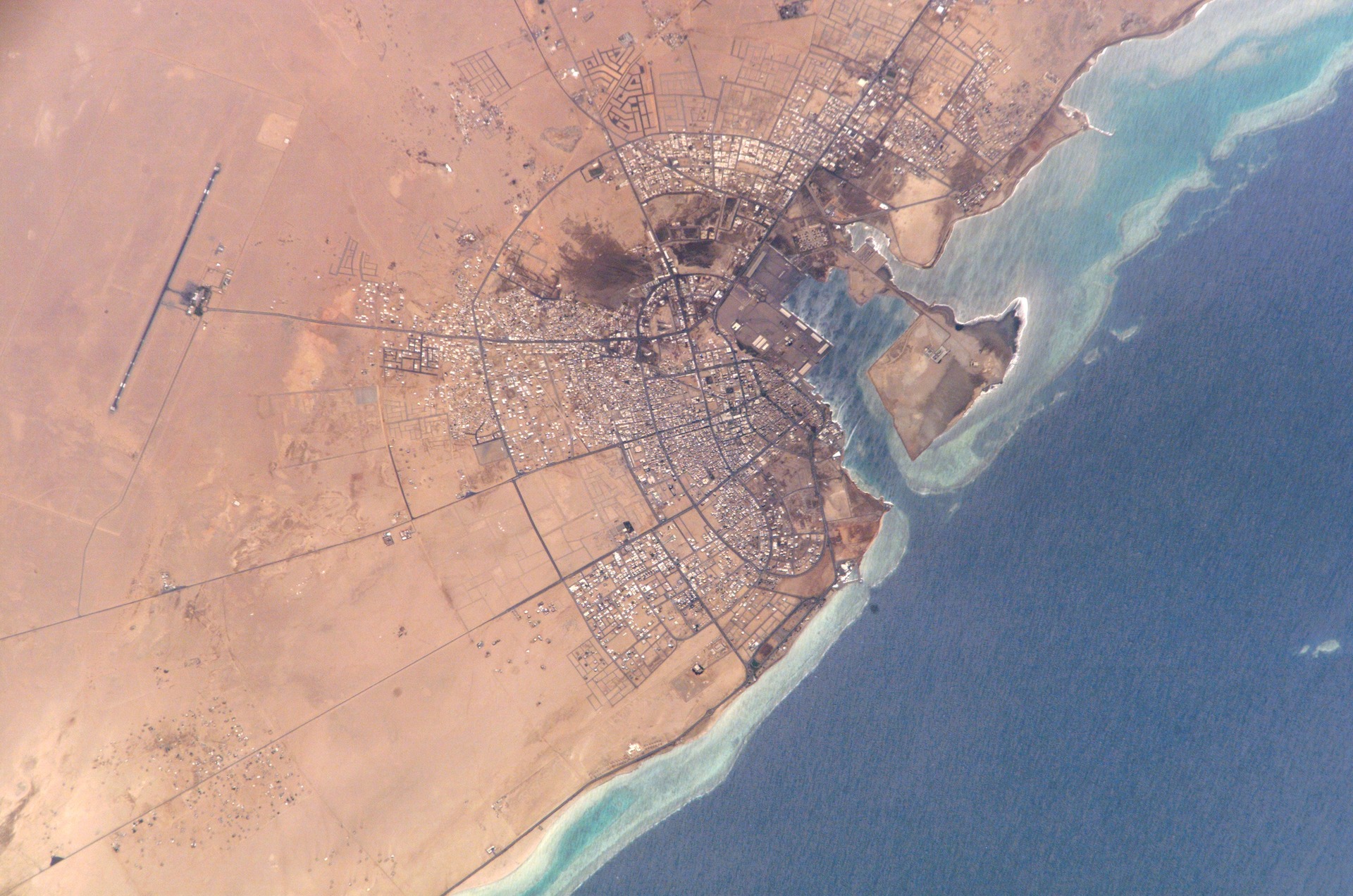
The East-West Pipeline connecting Saudi Arabia’s Eastern Province oil fields to the Red Sea port of Yanbu has a delivery capacity of 7 million barrels per day, but Yanbu’s port infrastructure is the binding constraint. Argus Media reported that Yanbu handled 47 VLCC loadings in March 2026 — four times its pre-war average of 11–12 per month — with throughput running at approximately 4.4 million bpd by late March as loading rates accelerated through the month. That is an extraordinary operational achievement and it is still not enough. Yanbu’s maximum port capacity is approximately 5.9 million bpd; pre-war Saudi Hormuz-routed exports ran 7–7.5 million bpd, leaving a structural gap of 1.1–1.6 million bpd that only Hormuz transit can fill.
The gap is not theoretical. It represents roughly $110–160 million per day in lost export revenue at current prices — revenue the kingdom needs to fund a fiscal position that was already strained before the war. The IRGC’s mine chart, published between February 28 and April 9, declared standard shipping lanes a danger zone and redirected vessels into a 5-nautical-mile corridor between Qeshm and Larak islands inside Iranian territorial waters. Mine clearance alone requires approximately 200 square miles of sweeping — a 51-day minimum based on the 1991 Kuwait benchmark — and the US decommissioned its four Avenger-class mine countermeasure ships from Bahrain in September 2025. Even if CENTCOM’s destination-based exemption were honoured by every IRGC patrol crew in the strait, physical mine risk does not respect legal categories. Until those lanes are swept, the paper corridor carries a literal explosive risk that no exemption letter can defuse. The US blockade changes who controls the paperwork. The mines do not read paperwork.
Background
The Strait of Hormuz, 21 miles wide at its narrowest point, channels roughly 20 per cent of global oil supply in normal conditions. The Iran-US conflict, which began with Iranian strikes on Saudi and Gulf targets in late February 2026, has produced the deepest disruption the strait has experienced since Iran and Iraq both targeted tankers between 1984 and 1988. During the Tanker War, attacks disrupted approximately 2 per cent of transiting vessels; the current crisis has removed 84 per cent of traffic — roughly 40 times more severe by proportion. The critical difference: in the 1980s, Iran kept the strait open because it needed Hormuz for its own exports. In 2026, Iran’s revenue strategy is built on controlling the strait, not exempting itself from its closure.
The US attempted a similar protection mission during the Tanker War under Operation Earnest Will in 1987–88, reflagging Kuwaiti tankers and providing direct naval escorts. IRGC harassment continued throughout, because IRGC targeting was strategic, not destination-based — a pattern that maps directly onto the current crisis. UNCLOS Article 37 establishes transit passage rights through Hormuz, but Iran, the United States, and Israel are all non-parties to UNCLOS. The rights rest on customary international law, creating the enforcement ambiguity that allows both CENTCOM and the IRGC to claim legal authority over the same water.
FAQ
Does the US blockade apply to all ships in Hormuz?
No. CENTCOM’s operational order is limited to two categories: vessels entering or departing Iranian ports and coastal areas, and vessels that have paid Iran’s toll. Ships transiting Hormuz to non-Iranian destinations are explicitly exempted. The IRGC does not recognise this distinction; it applies its own coordination requirements to all vessels regardless of destination, creating overlapping and contradictory enforcement regimes in the same waterway. Whether a ship is “exempt” depends on which navy is closer when the question arises. The first empirical test came on Day 1: the Rich Starry — a sanctioned Chinese tanker OFAC-blacklisted for Iran sanctions evasion — completed an unchallenged Hormuz transit carrying UAE-loaded methanol, demonstrating that cargo origin, not vessel ownership, is the operational variable the blockade cannot close.
Could the US Navy escort Saudi tankers through Hormuz?
In theory, yes — and the 1987–88 Earnest Will precedent involved exactly this for Kuwaiti tankers. In practice, the IRGC declared on April 12 that any military vessel approach to Hormuz “will be dealt with severely” and constitutes a ceasefire violation. Escort operations would require US warships to enter the IRGC-controlled corridor, potentially triggering the very military confrontation the ceasefire was meant to prevent. The USS Frank E. Petersen Jr. (DDG-121) and USS Michael Murphy (DDG-112) transited Hormuz on April 11 and received an IRGC “last warning” radio call — an exchange that demonstrated both US willingness to transit and IRGC willingness to escalate.
What happens to ships that paid Iran’s toll before the blockade started?
CENTCOM’s order to “seek and interdict every vessel in International Waters that has paid a toll to Iran” does not specify a start date for toll payments. Vessels that paid the IRGC’s $1-per-barrel charge to transit in March or early April are potentially subject to US interdiction anywhere on the high seas — even months after the payment — creating retroactive legal exposure for hundreds of commercial ships. Several major shipping law firms, including Hill Dickinson, have advised clients to assume the broadest possible interpretation until CENTCOM issues specific guidance on retroactivity.
Why is Brent at $103 and not higher if Hormuz is this disrupted?
The market is pricing in Yanbu’s demonstrated ability to handle 4.4 million bpd of Saudi exports without Hormuz, plus expectations that the ceasefire will eventually restore some transit. Goldman Sachs projects $120 Brent by Q3 if conditions remain severely limited through July. The current price also reflects demand destruction: at $103, Asian refiners are already cutting runs and substituting non-Gulf supply where possible. The $100 handle is a balance between supply disruption and demand response — not a verdict on whether the paper corridor works.
Has any government formally recognised Iran’s Hormuz toll?
No government has recognised the toll as lawful. IMO Secretary-General Arsenio Dominguez explicitly stated on April 12 that “countries do not have the right to introduce tools or payments or charges on these straits” and called the toll “against international law.” China has facilitated toll payments through Kunlun Bank outside the SWIFT system, and Iraq’s exemption from the toll was negotiated bilaterally with Tehran. The toll exists in a space between legal rejection and operational reality: no one endorses it, but ships that refuse it do not transit.